The question that changes everything
Does your company really sell a product, or does it sell “a product stuck to a channel” it no longer knows how to leave?
The context: when the channel eats the product
In many service companies (airlines, hospitality, financial services, SaaS, and others), the business usually starts in the direct channel: their own website, app, or internal sales team. It works, grows, and integrates with internal processes, and without noticing it, the product ends up being designed for that single channel, as if both were the same thing.
When growth pressure arrives, new channels appear: OTAs, marketplaces, affiliates, partners, third-party apps. The most common mistake then is trying to sell exactly the same thing in the same way everywhere. The result is cannibalization, price wars against yourself, and increasing dependence on giants that keep a significant share of your margin.
The problem: same product, different channel, same war
These are the three major recurring roadblocks:
- Product glued to the channel. The service is so integrated with a system (for example, an OTA or a financial marketplace) that moving it to a different environment almost requires “reinventing” it: processes, pricing, customer experience, and conditions are all welded to the channel.
- Channels that compete with each other. When you copy prices, conditions, and messages across all channels, you stop segmenting and start making your channels steal sales from each other instead of growing the total demand.
- Dependence on giants. Marketplaces, OTAs, and mass distribution platforms offer huge reach, but at the cost of high commissions, loss of control over the customer, and lower operating margins, easily reaching 20 percent of your revenue. In airlines and hotels, this is very obvious: lots of sales through third parties, but with less visibility of the customer and less capacity to grow revenue per passenger or per room.
The same happens in digital services ecommerce: courses, insurance, financial products, or subscriptions that live “locked in” on third-party platforms, with little control over data, dynamic pricing, or recurrence strategy.
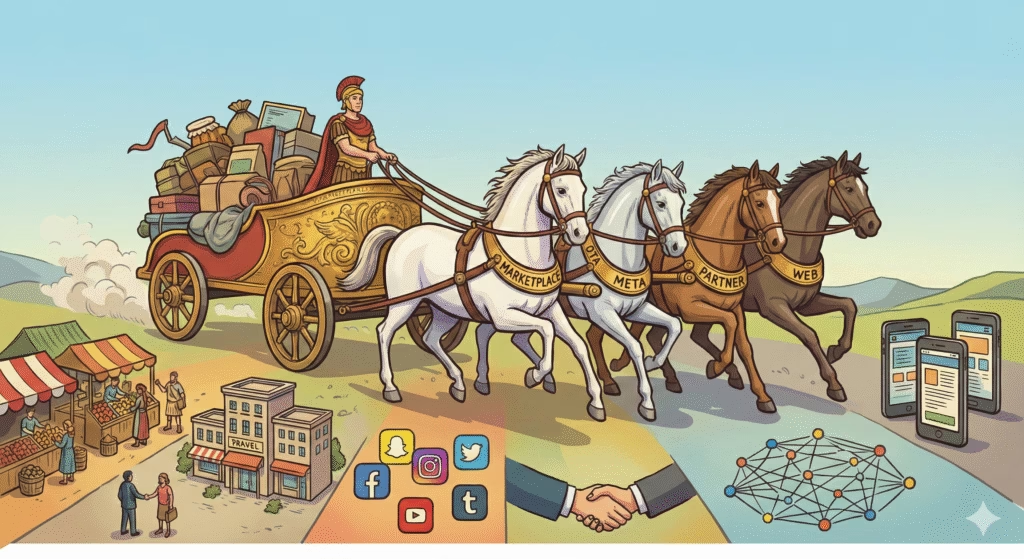
How to design a truly multichannel product
Channel-agnostic product: think like open banking
The first key is to design the product as “modules” that can connect to different channels, instead of building it around a single one. Open banking is a good reference: APIs allow the same service (for example, account aggregation or credit scoring) to be consumed from apps, websites, marketplaces, or banking partners without changing the essence of the product.
Fintech companies such as Fintonic have combined open banking services with a loan marketplace model, connecting multiple financial institutions with end users through the same value proposition.
The key is separating the core of the service (data, logic, business rules) from the presentation layer and the channel so that you can adapt UX, pricing, and messaging without rebuilding the product each time.
If you work in airlines, hospitality, or financial services, this same modular approach can be applied to bookings, bundles, insurance, upgrades, or additional services.
Different products for different channels
The second step is accepting something that can be painful: not all channels should sell the same thing, nor under the same conditions.
Use marketplaces and OTAs for entry products or less critical inventory: less flexible fares, standard rooms, less demanded seats, and lower-ticket financial products, for example.
Reserve your best value proposition for the direct channel: better combination options, more flexibility, exclusive bundles, special conditions for loyal customers, or benefits that third parties cannot replicate, such as advanced personalization or additional services.
This way, you turn third-party channels into acquisition showcases, not the place where you give away your best margin. On Consumer Services Hub, you can find related articles on how to reduce dependence on OTAs and marketplaces by prioritizing the direct channel and optimizing the booking flow to capture more value in your own ecosystem.
Building recurrence in your own channel
Getting the first sale through a third party can make sense, but relying on them for the second, third, and fourth no longer does. Some useful levers are:
Designing journeys to “bring the customer home” in the next interaction, such as registering in your loyalty program, exclusive benefits for booking direct, and well-planned post-service communication.
Measuring KPIs such as customer lifetime value and direct channel growth to see whether customers acquired through third parties eventually migrate to your channel or stay “trapped” in the marketplace.
Implementing sector-specific tactics:
- Airlines: incentivise “manage my booking” in your own channel and offer upgrades or ancillaries only on your own website or app.
- Hotels: offer exclusive benefits for booking direct (late check-out, better room location, extras) instead of competing only on price.
- Financial services: show recurring, personalised offers for complementary products in your app or on your website after the customer first arrives via a comparison site or aggregator.
Other Consumer Services Hub content explores in more depth how to use metrics such as look to book, RevPAR, or average PNR to measure whether your direct channel strategy is capturing recurrence effectively.
Smart cross-selling and upselling
When the product is inventory-based (airline seats, hotel rooms, policies, or subscriptions with add-ons), the direct channel is your best playground to grow average ticket value without paying more commissions.
- In airlines, cross-selling baggage, seat selection, priority boarding, or travel insurance can significantly increase ancillary revenue if it is well integrated into the booking flow.
- In hospitality, room upgrades, breakfast, late check-out, or local experiences are clear upselling opportunities that a third party cannot always exploit with the same level of personalisation.
- In financial services, insurance bundles, savings products, or credit lines can be offered directly from your app, using transactional data and more refined risk models that come from open banking.
The key is designing these additional services from the beginning to sell better in your own channel, where you control context, data, and timing.
Conclusions and next steps
The real mindset shift is to stop thinking “I sell this service wherever I can” and start thinking “I design a multichannel portfolio where each channel has a clear role in acquisition, margin, and recurrence.” This requires building channel-agnostic products, using third parties mainly for acquisition, using your direct channel to monetise, and creating solid cross-selling and upselling strategies that do not rely on intermediaries.
If this problem sounds familiar (excessive dependence on OTAs or marketplaces, margin pressure, and difficulty differentiating your direct channel), you will find more articles on Consumer Services Hub about how to optimise your services ecommerce, how to improve your direct channel conversion rate, and how to build a truly data-driven revenue optimisation strategy.
If you are ready to take the next step and want a partner who has already worked on these challenges with airlines, hotels, and financial services companies, the Consumer Services Hub team can help you: https://consumerserviceshub.com/contact-us/