Did you know that travelers rarely buy on their first visit? They compare options and return several times before making a decision.
Getting started with an airline’s e-commerce strategy can feel overwhelming at first. However, it is essentially a structured set of levers that serve one primary objective: revenue generation. Ultimately, everything comes down to the revenue produced through the airline’s direct sales channel.
For an airline, the direct channel is not just a showcase, it´s the fundamental driver of profitability. Below are the key levers that influence e-commerce revenue and how to optimize each one to maximize ROI.
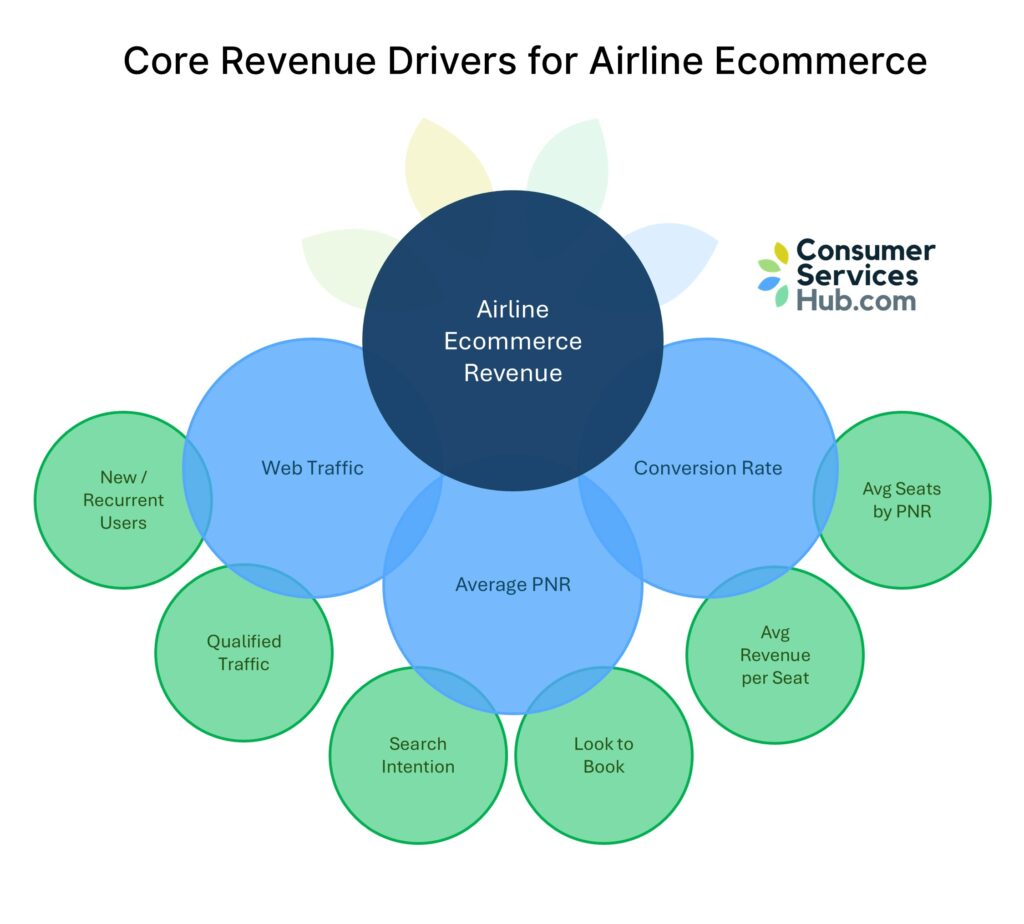
There are three main drivers of revenue: web traffic, conversion, and average PNR. As with any type of e-commerce, these determine the performance of the channel.
1. Web Traffic
This indicator measures both the volume and the quality of visitors to the online sales channel. Achieving the lowest possible acquisition cost is critical for building a profitable business while maintaining healthy margins.
With digital advertising costs continuously rising, attracting relevant and recurring traffic is more important than ever. Potential customers often return several times before making a purchase. Facilitating this research and loyalty journey reduces CPA (Cost per Acquisition) and improves campaign ROI.
To achieve this, it is key:
- Obtain user permission (opt-in) to personalize offers and communications.
- Segment audiences based on search history and behavior.
- Generate valuable content (e.g., destination guides, route comparisons, and promotions) to encourage repeat visits.
- Personalize offers. The more accurately we understand customer interests, the easier it becomes to sell tickets.
Even if a user finds what they’re looking for, they won’t always buy immediately—but don’t worry, they’ll come back. It will likely take more than 5 interactions before they finally make the purchase.
Unlike other e-commerce industries, airlines benefit from a unique source of qualified traffic: metasearch engines. Platforms like Kayak, Skyscanner, Google Flights, and Dohop act as affiliates that direct high-intent users straight into the booking flow. Having strong connectivity and a competitive product offering in these channels is crucial for capturing valuable traffic.
2. Conversion Rate and Look to book
Conversion rate measures the percentage of sessions that result in a purchase. To improve it, airlines must focus on two critical components:
- Search Intention through the search engine and landing pages Pages : This reflects the effectiveness of capturing users with genuine travel intent (e.g., searches for routes, dates, or airlines). A well-structured landing page system, and a great search component are the keys. Components should clearly display destinations, minimum prices, and guide the user seamlessly into the booking flow.
- Look to Book : Once the user sees the product and price, the next step is persuasion. Elements such as pricing bundles, ancillary services, value proposition, user experience, and payment flexibility are decisive in converting interest into sales.
Optimizing the search experience and simplifying the booking journey significantly boosts conversion and, consequently, revenue. A higher seat factor ultimately translates into stronger profitability.
3. Average PNR
The PNR (Passenger Name Record) average reflects the revenue per booking. It is essentially calculated by dividing the total revenue per reservation by the number of passengers included in that reservation. Key elements include:
- Average seat: How much revenue we’re earning per average seat. This metric is based on the fare portion and the ancillary portion. Depending on the airline’s business model (whether it’s full -service or low-cost) , the fare portion is calculated based on the airline’s business model. cost ), the composition will be different, ranging from 10% to 40% of revenue by ancillaries . To improve the average PNR, 3 stages can be managed: The purchase process, in which greater pressure to have a higher ticket would worsen the Look to Book, and post-purchase, where the user has already purchased the ticket and is “captive” to purchase additional services during the reservation management time, as well as during the Online Check -in, where an attempt will be made to maximize this metric.
- Average seats per PNR : This metric is determined by the number of passengers traveling per PNR, often incentivized through discounts for groups and families, and on the other hand, the type of flight being sold, whether it is a one-way, round-trip, or multi-destination flight. Connecting flights are also a good lever to improve this metric, and in recent years, airlines with a connecting hub have become popular, especially Dubai and Doha, optimizing operations.
By increasing both the average fare and ancillary revenue per seat, while also maximizing PNR occupancy, airlines can substantially raise total revenue.
Conclusion
To grow an airline’s e-commerce business, it is crucial to:
- Drive qualified traffic at the lowest cost possible.
- Optimize the conversion funnel to reduce friction and maximize bookings.
- Increase average PNR through strategic upselling, ancillary services, and optimized booking structures.
These three levers form the foundation for sustainable revenue growth.
To take your airline’s e-commerce to the next level, contact us at www.ConsumerServicesHub.com and discover how our digital consulting services can help you achieve your business objectives.