Website personalisation: use cases and the architecture required
Personalisation means using a reliable signal to make a useful decision in a specific context. A recommendation based on a weak signal is worse than no recommendation at all.
Written for: Ecommerce, CRO, analytics, CRM, data, personalisation and digital product leaders.

Personalisation means using a reliable signal to make a useful decision in a specific context.
The business problem behind the topic
Personalisation is often reduced to changing banners by audience. Without a clear decision, identity control and incremental measurement, variants add cost and risk without improving experience. In service businesses, the decision does not end when a customer clicks “buy”: the digital promise must connect with operations, service delivery, data and profitability. This is why the topic should be treated as a business decision rather than an isolated marketing or technology enhancement.
The dimensions that need to be resolved
A sound approach combines four dimensions. Reviewing them separately helps expose friction; managing them as a system allows the direct channel to grow without transferring complexity to customers or the organization.
1. Use cases and value
Prioritise decision support: continuity, market-specific content, product ordering, offers, reassurance, recovery and service. Each case should state who benefits and which behaviour it aims to change. The starting point is a concrete decision: which signal will be used, for whom, with which action and which outcome should change. Collecting more data does not replace this definition.
2. Signals and identity
Distinguish anonymous context, session, known customer and household. Define confidence, freshness, consent and fallback so weak data is not overinterpreted. The signal needs quality, identity, consent, freshness and a fallback when confidence is insufficient. Without these conditions, automation amplifies errors.
3. Decisioning and delivery
Choose rules, models, APIs, edge, server or client according to latency, control and experience. Content needs components, metadata, preview and governance. Instrumentation should record exposure, response, outcome and guardrails. Only then can the organisation distinguish correlation, attribution and incremental effect.
4. Measurement and safety
Maintain controls, holdouts, exposure logging, fairness and guardrails. Personalisation should be explainable, reversible and respect privacy and expectations. The capability requires ownership, data contracts, QA, monitoring and a learning cadence. Without operations, the use case degrades after launch.
A practical roadmap
Sequence matters. Starting with a tool or a feature list usually creates an expensive project that is difficult to govern. The following roadmap forces the business decisions first and the implementation second.
1. Inventory decisions. Locate moments where a variant can reduce uncertainty or effort.
2. Prioritise signal-to-action. Select cases with reliable signals and actionable responses.
3. Design the minimum architecture. Connect profile, decision, content, delivery and logging.
4. Pilot with a holdout. Start with one measurable case and retain a baseline experience.
5. Scale through components. Reuse content blocks, rules and measurements.
How to measure whether it works
A useful dashboard does not accumulate indicators: it connects behaviour, economics and execution. Metrics should be reviewed by segment, device, market and journey stage so that averages do not hide the actual problem.
Decision coverage: Sessions with a valid signal and action.
Fallback rate: Cases returning to baseline because of low confidence.
Incremental lift: Causal change in conversion, margin or service outcome.
Content reuse: Variants built with governed components.
Latency and error: Decisioning impact on performance and stability.
Common mistakes that reduce impact
Creating segments because data exists rather than because it changes a decision.
Hiding important information from misclassified audiences.
Failing to log which variant each user received.
Scaling content before proving incremental value.
The warning sign is simple: if the project can be described only by the name of a platform, a campaign or a redesign, it is probably not yet sufficiently connected to the business outcome.
Conclusion
Effective personalisation is usually less spectacular and more useful than the commercial promise. It reduces steps, remembers context, orders options and explains better. Its architecture should always preserve a strong baseline experience.
Consumer Services Hub designs measurement, CRO and personalisation programmes connected to business outcomes and real execution capacity.
Consumer Services Hub - Strategic ecommerce consultancy for B2C service companies

Written by
Rodrigo Maroto
Founder of Consumer Services Hub. Consultant and strategist with 15+ years of experience in ecommerce, digital product management, and consumer services.
View LinkedIn profileBuild a conversion programme
Experimentation and personalisation with governance, not one-off tests.
Talk to usWhether you're launching a new digital channel, optimizing an existing one, or unlocking the next stage of growth — we're ready to help.
Related articles
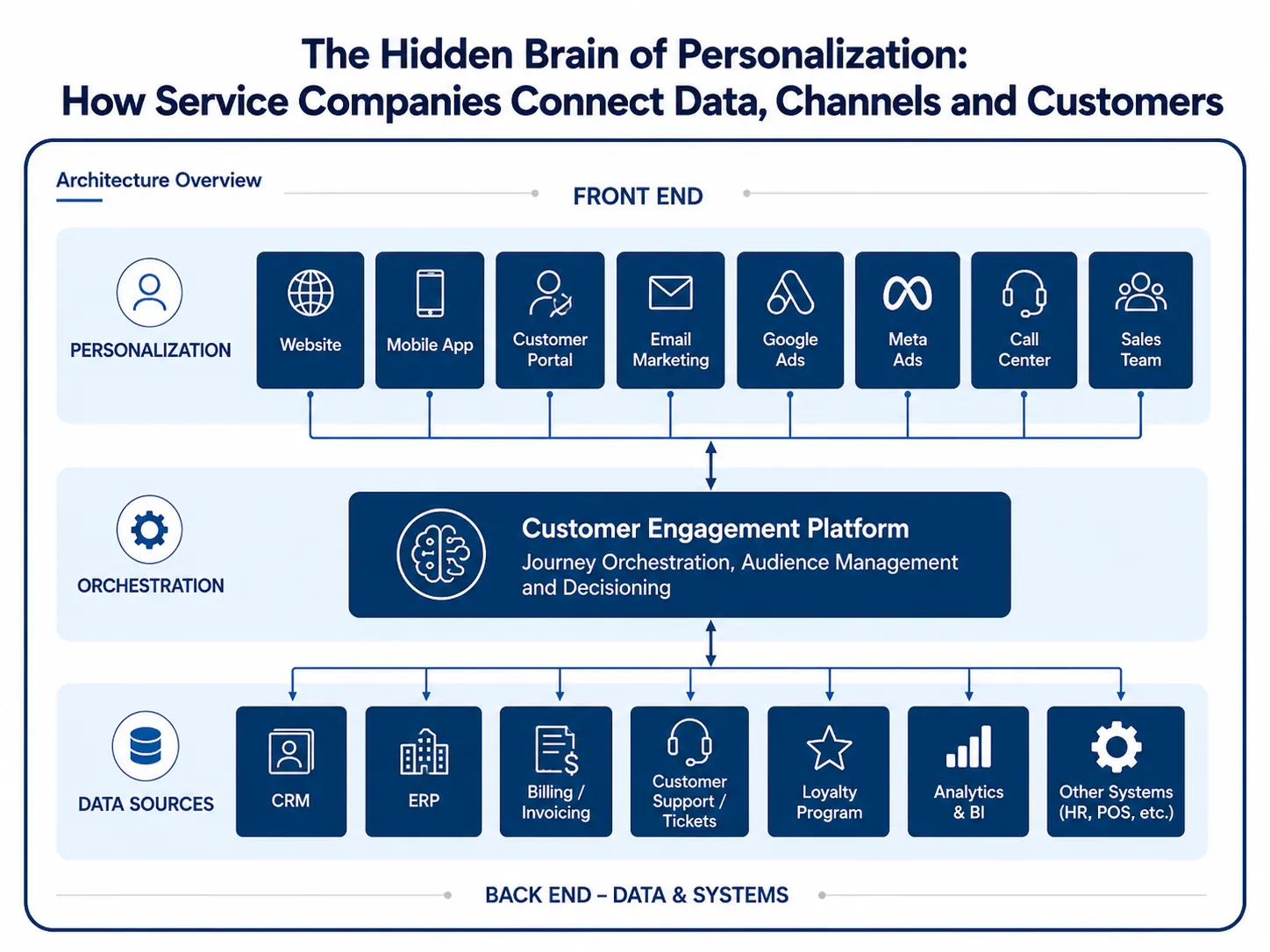
The invisible engine that turns data into sales
How to choose a customer engagement and personalization platform based on the size and maturity of your ecommerce. Companies don't need more campaigns: they need a layer able to turn scattered data into relevant decisions for each customer, in each channel, at the right moment.
AI agents in customer service: from distribution to servicing
Automating the answer is easy; automating the resolution requires permissions almost nobody has granted. An assistant that can explain the change policy but cannot change the flight has merely moved the wait one step further along.
Server-side tracking and ecommerce measurement
The goal is to create a controlled and reconcilable measurement layer, not to bypass privacy or browser constraints. A server-side setup built purely to dodge a browser block will need rebuilding the next time the rules change.