How to audit a direct sales channel step by step
A good audit reconstructs the economics and the complete customer journey rather than producing a list of issues. What matters is whether the findings change a decision, not how many issues the audit surfaces.
Written for: CDOs, Chief Ecommerce Officers, digital business, product and transformation leaders.
A good audit reconstructs the economics and the complete customer journey rather than producing a list of issues.
The business problem behind the topic
A direct-channel audit often becomes a review of screens or campaigns. That approach does not explain whether the channel creates margin, where demand is lost, which frictions originate in operations or which decisions need to change. In service businesses, the decision does not end when a customer clicks “buy”: the digital promise must connect with operations, service delivery, data and profitability. This is why the topic should be treated as a business decision rather than an isolated marketing or technology enhancement.
The dimensions that need to be resolved
A sound approach combines four dimensions. Reviewing them separately helps expose friction; managing them as a system allows the direct channel to grow without transferring complexity to customers or the organization.
1. Scope and channel economics
Define the products, markets, devices, demand sources and costs included in the channel. The baseline should cover net revenue, margin, distribution, payment, servicing and fulfilment costs. The practical test is to link the decision to a priority customer, a concrete need and an economic hypothesis. This prevents strategy from becoming a collection of unfocused initiatives.
2. Data quality and definitions
Verify that sessions, users, searches, checkout starts, payments and sales are measured with stable rules. Gaps between analytics, backend and finance must be quantified before interpreting the funnel. It should become visible in product, content, pricing, terms and service. A proposition that exists only in an internal presentation will not change customer behaviour.
3. End-to-end experience and processes
Review not only the interface but also availability, pricing, conditions, errors, payments, confirmations, changes and support. Many visible frictions are symptoms of internal rules or integrations. Dependencies across teams and systems should be mapped because every manual exception, duplicated data point or contradictory rule eventually appears as friction or operating cost.
4. Capabilities and governance
Assess ownership, operating rituals, a prioritised backlog, experimentation and technical capacity. A channel can have strong ideas and remain stagnant because ownership or delivery speed is missing. It also needs an owner, decision rules and a review cadence. Without governance, each function optimises its local metric and the combined outcome is lost.
A practical roadmap
Sequence matters. Starting with a tool or a feature list usually creates an expensive project that is difficult to govern. The following roadmap forces the business decisions first and the implementation second.
1. Define questions and scope. Agree which decisions the audit must inform, the period under review and the relevant economic units.
2. Build a reliable baseline. Reconcile analytics, transaction, marketing, operations and finance data.
3. Walk the journey with evidence. Combine quantitative analysis, user testing, heuristic review and internal interviews.
4. Quantify each opportunity. Estimate impact, cost, dependency, confidence and timing so priorities are not based on opinion.
5. Turn findings into a plan. Group quick wins, structural changes and strategic decisions with owners and metrics.
How to measure whether it works
A useful dashboard does not accumulate indicators: it connects behaviour, economics and execution. Metrics should be reviewed by segment, device, market and journey stage so that averages do not hide the actual problem.
Net conversion: Valid sales over eligible demand after excluding duplicates, measurement errors and cancelled transactions.
Stage leakage: Loss of users and value between search, selection, checkout, payment and confirmation.
Contribution margin: Result after variable acquisition, distribution, payment and servicing costs.
Failure and recovery rate: Technical or payment errors, retries and the proportion of customers who ultimately complete.
Opportunity value: Annualised impact weighted by confidence, effort and implementation time.
Common mistakes that reduce impact
Limiting the audit to UX while ignoring pricing, inventory, data and operations.
Interpreting global averages that mix different markets, devices and products.
Turning every anomaly into a recommendation without demonstrating economic impact.
Delivering a list of problems without priorities, owners or a review mechanism.
The warning sign is simple: if the project can be described only by the name of a platform, a campaign or a redesign, it is probably not yet sufficiently connected to the business outcome.
Conclusion
An audit should reduce uncertainty and show where to act first. Its value is not the number of findings, but the ability to connect evidence, impact and a realistic sequence of decisions.
Consumer Services Hub turns complex strategic decisions into a diagnosis, a target model and an executable roadmap.
Consumer Services Hub - Strategic ecommerce consultancy for B2C service companies

Written by
Rodrigo Maroto
Founder of Consumer Services Hub. Consultant and strategist with 15+ years of experience in ecommerce, digital product management, and consumer services.
View LinkedIn profileReview your direct channel strategy
A focused session to pressure-test your ecommerce roadmap and priorities.
Book a strategy sessionWhether you're launching a new digital channel, optimizing an existing one, or unlocking the next stage of growth — we're ready to help.
Related articles
How to build a business case for direct-channel transformation
A defensible business case shows current economics, the counterfactual and a range of outcomes rather than one optimistic number. A single number invites a single objection; a range survives the room.
The direct channel business case to present to the board
The board does not approve a channel strategy: it approves a capital allocation with declared risk. A case that only promises to grow the direct channel without saying at whose expense reads as a preference, not an investment.
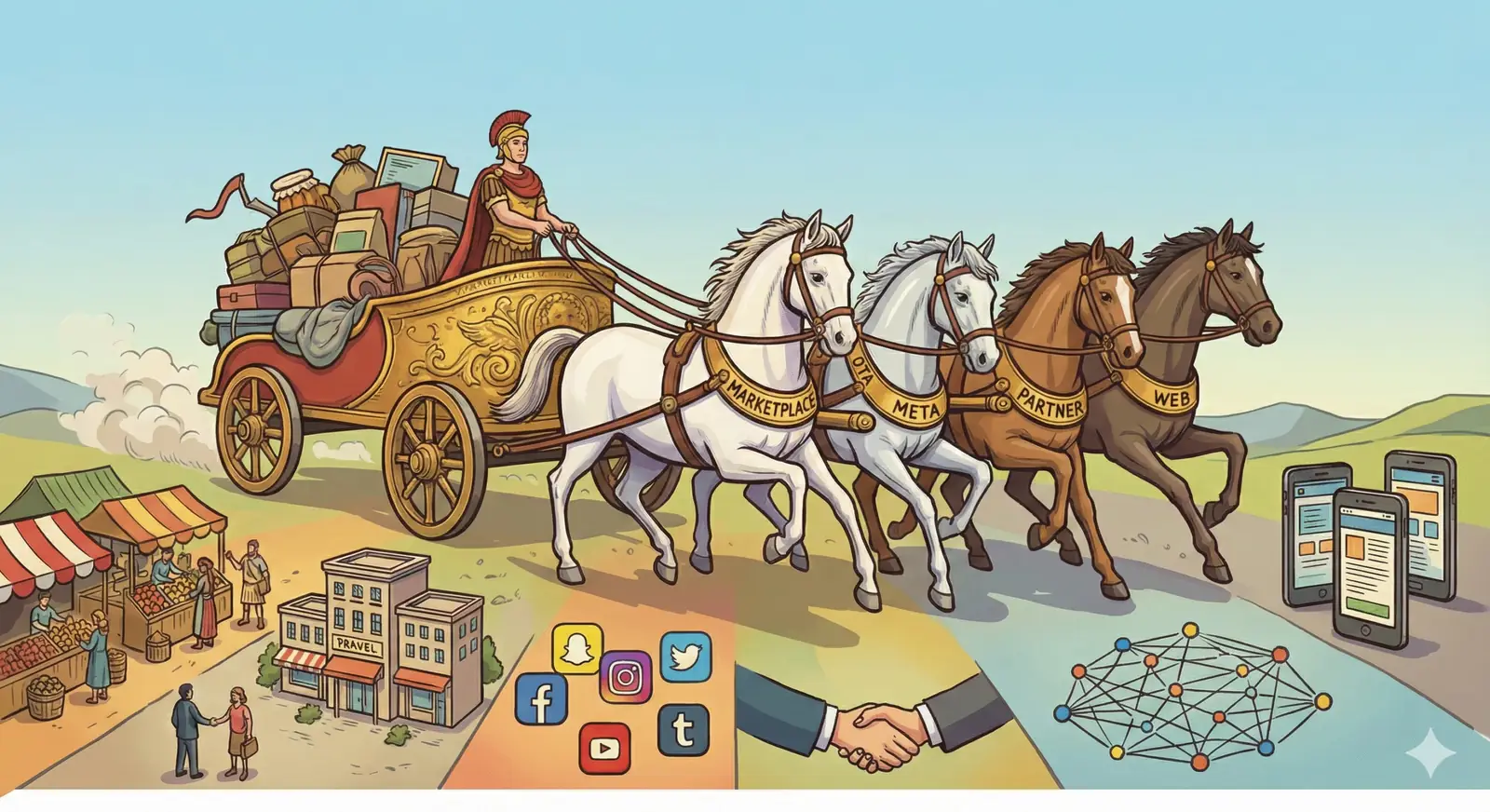
The channel is not the product: when distribution is the key
In the service industry, the temptation to treat the digital channel as the product itself is common. But the channel is just a vehicle — and confusing the two leads to strategic misalignment.