Key factors for increasing revenue in an airline e-commerce site
Travellers rarely buy on their first visit. These are the key levers that influence ecommerce revenue in an airline site, from traffic to conversion.
Introduction
Travelers rarely buy on their first visit. They compare options and return several times before deciding.
Getting started with an airline's e-commerce strategy can feel overwhelming. But it's essentially a structured set of levers that serve one objective: revenue generation.
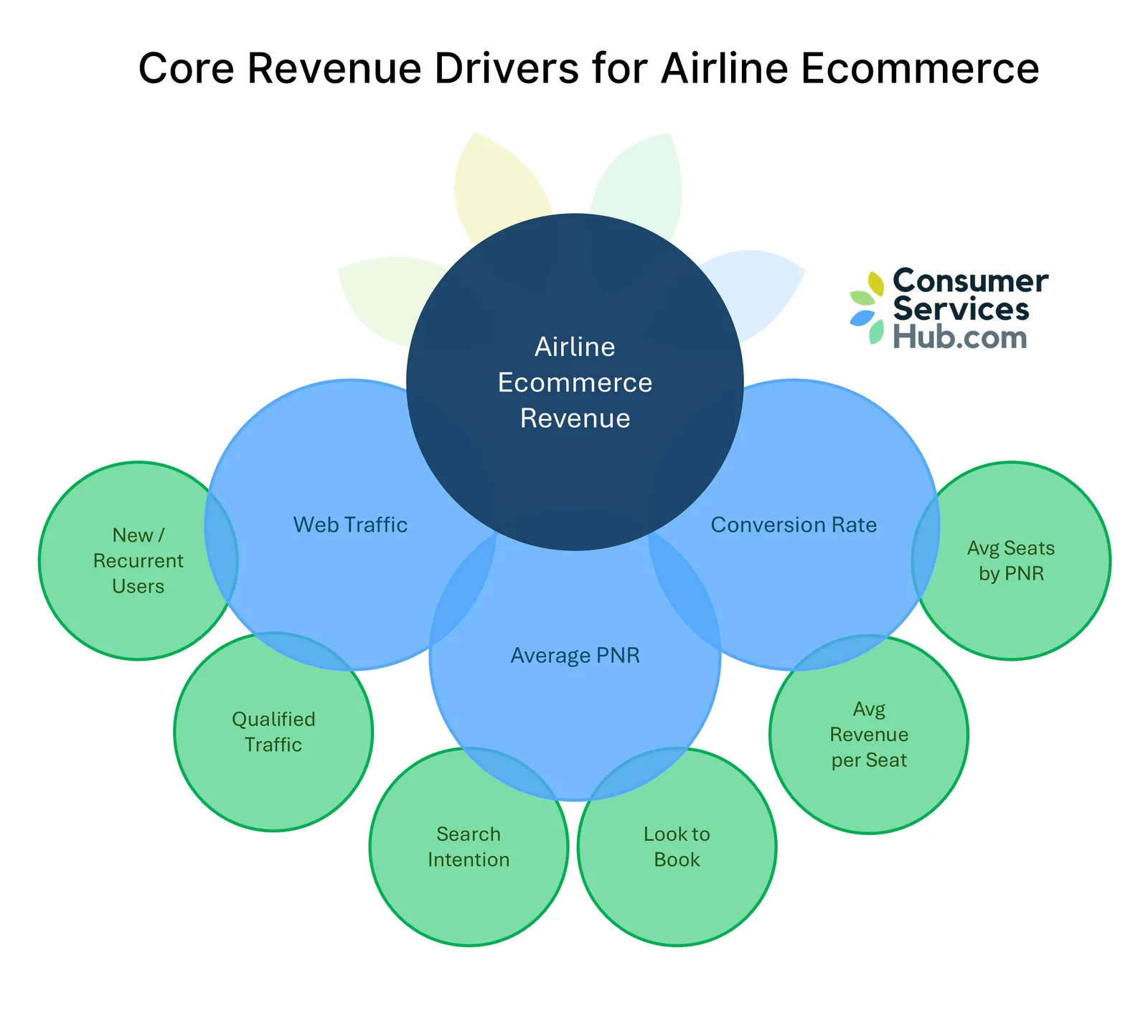
Three main drivers: web traffic, conversion, and average PNR.
Treating revenue as the product of exactly these three levers (traffic × conversion × average PNR) is useful precisely because it forces every initiative to declare which lever it's meant to move. A redesign that doesn't clearly improve traffic quality, conversion, or average PNR value is, by definition, not a revenue initiative — however good it looks.
1. Web Traffic
This measures both the volume and quality of visitors. Achieving the lowest possible acquisition cost is critical.
Key actions: obtain user permission for personalization, segment audiences, generate valuable content, and personalize offers.
Airlines benefit uniquely from metasearch engines: Kayak, Skyscanner, Google Flights, Dohop.
Quality matters as much as volume: a spike in traffic from a broad-match paid campaign that isn't route- or date-relevant will show up as more visits and a worse conversion rate at the same time, which can mislead teams into 'fixing' a funnel that was never broken — the traffic mix was.
2. Conversion Rate and Look to Book
Conversion rate measures the percentage of sessions resulting in a purchase. Focus on Search Intention and Look to Book.
Optimizing the search experience and simplifying the booking journey significantly boosts conversion.
Look to Book — the ratio of searches to actual bookings — is particularly useful because it's largely insulated from traffic-quality noise: a visitor who searches specific dates and a specific route has already shown real intent, so a poor Look to Book ratio points squarely at the booking flow itself, not at acquisition.
3. Average PNR
PNR average reflects revenue per booking. Key elements: average seat revenue (fare + ancillary, 10-40%) and seats per PNR.
By increasing both average fare and ancillary revenue while maximizing PNR occupancy, airlines can substantially raise total revenue.
The two components pull in different directions if managed carelessly: pushing ancillary attach rate too aggressively at checkout can suppress conversion, which lowers total PNR volume even as average PNR value rises. The metric that matters for the business is total revenue, not average PNR in isolation — so ancillary strategy needs to be tested against overall conversion, not just against attach rate.
Conclusion
Drive qualified traffic at the lowest cost. Optimize the conversion funnel. Increase average PNR through strategic upselling.
These three levers form the foundation for sustainable revenue growth.
In our experience running these audits, the lever with the most unclaimed value is usually conversion, not traffic or PNR — because it's the one most teams have never measured step-by-step. Traffic has a media budget and a clear owner; PNR has a revenue management team. Conversion often has neither, and quietly leaks more revenue than either of the other two.

Written by
Rodrigo Maroto
Founder of Consumer Services Hub. Consultant and strategist with 15+ years of experience in ecommerce, digital product management, and consumer services.
View LinkedIn profileGrow airline direct revenue
We audit booking funnels, ancillaries and retailing capabilities end to end.
Talk to usWhether you're launching a new digital channel, optimizing an existing one, or unlocking the next stage of growth — we're ready to help.
Related articles

How to increase airline ancillary revenue
The goal is not to add more products, but to build useful, profitable and serviceable offers across the journey. An ancillary nobody wants at the moment it's offered is just clutter with a price tag.
How AI agents may reshape airline distribution
Preparation is not about adding a chatbot, but making offers and actions machine-readable, authorisable and auditable. An airline whose offers only a human can parse will be invisible to the agents that book on a traveller's behalf.
Airline metasearch: managing Google Flights, Skyscanner and Kayak
Strategy should optimise offer continuity and incremental contribution by market, not only cost per booking. The cheapest metasearch bid can still deliver the customer the airline would have won anyway.