The invisible engine that turns data into sales
How to choose a customer engagement and personalization platform based on the size and maturity of your ecommerce. Companies don't need more campaigns: they need a layer able to turn scattered data into relevant decisions for each customer, in each channel, at the right moment.
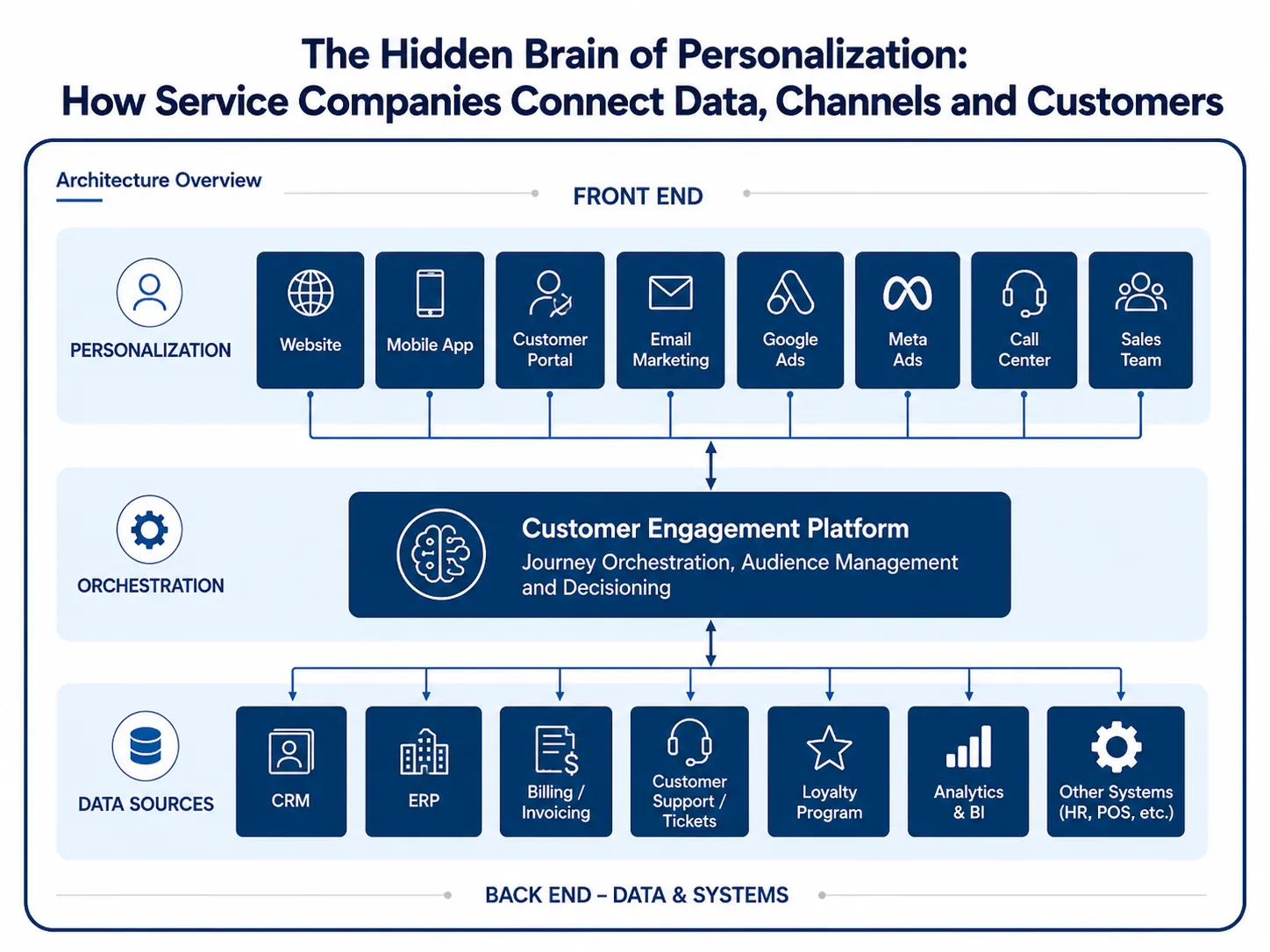
From campaigns to orchestration
Ecommerce growth and the multiplication of touchpoints have outgrown the model of campaigns and static lists. A service company can interact with the same customer through the website, an app, the private account area, email, advertising, the call center or the sales team. Every interaction generates data, but it also increases the risk of disconnected messages and repeated impacts.
Customer engagement and personalization platforms connect those signals and turn them into actions. Their value is not only in sending communications, but in deciding which content, service, offer or channel is most relevant for each customer — and how to coordinate that decision across the whole experience.
What are customer engagement and personalization platforms?
A customer engagement platform analyses customer behaviour, builds dynamic audiences and coordinates interactions across channels. Unlike traditional email marketing, it uses events, preferences, transactions and context to trigger personalized journeys in real or near-real time.
Personalization adapts the digital experience: it can modify a page, reorder services, recommend the next purchase or decide when an agent should step in. Advanced solutions include decisioning or next-best-action logic to prioritise the action with the highest expected value for both customer and business.
In a mature architecture, the platform sits between the data sources — CRM, ERP, billing, support, loyalty and analytics — and the activation channels. It connects those systems and returns decisions that are executed on the website, the ecommerce, advertising, email or the service and sales teams.
Which problems do they solve?
The first problem is fragmentation. One person can have different identifiers in the CRM, the marketing platform, the transactional system and the analytics stack. Without proper identity resolution, each channel works with a partial view and delivers an inconsistent experience.
The second is lack of coordination. If the website, the CRM, advertising and the call center act independently, the customer may receive a promotion after purchasing, or several contradictory messages. Audience orchestration sets priorities, exclusions and frequency caps.
The third is low relevance. Two users of the same ecommerce can have different needs, value and price sensitivity. Ecommerce personalization adapts messages, offers and services using behaviour, history, context, consent and availability.
They also enable experimentation. A/B tests, control groups and incremental measurement make it possible to tell a sale generated by personalization from one that would have happened anyway. The focus then shifts towards conversion, margin, repeat purchase and customer lifetime value.
What to consider before choosing a platform
The decision should start from the use cases. Recovering abandonment, personalizing the website, recommending services or assisting the sales team all demand different capabilities. A solution that excels at multichannel journeys may not be the best customer data platform, and a solid CDP may still need another tool to execute communications.
Data and identity model: it must represent customers, accounts, services, purchases and incidents, and stitch anonymous and identified users together.
Integration and real time: evaluate APIs, SDKs, connectors, latency and the ability to push decisions into the ecommerce or the CRM.
Orchestration and personalization: it must coordinate channels, control commercial pressure and decide which experience to show.
Governance and privacy: consent must be applied by purpose and channel, with traceability and retention policies.
Autonomy and measurement: marketing needs to build audiences and experiments with controls, versioning and incremental measurement.
Total cost: the comparison must include profiles, events, messages, API calls, channels, implementation and a three-year TCO.
You also need to define which system owns each function. CRM, CDP, marketing automation and personalization tools usually overlap. Without a clear architecture, several technologies are bought for the same problem and none consolidates as the reliable source of identity, audiences or decisions.
The current market by ecommerce size
Ecommerce expansion is driving this category. Spain's CNMC reported that ecommerce exceeded 114.8 billion euros in 2025, 20.6% more than the previous year. Eurostat notes that 24% of European Union companies make electronic sales, rising to 48% among large companies. Demand no longer comes only from retail: travel, finance, telecommunications, mobility and education also compete through personalized digital experiences.
The right platform changes with volume and maturity. It is not only about revenue: the number of profiles, events, channels, countries, catalogue complexity and technical capacity all matter.
Small ecommerce — dominant need: fast automation and demand recovery. Usual architecture: integrated suite, templates and standard connectors. Market examples: Connectif and marketing automation solutions.
Mid-sized ecommerce — dominant need: dynamic audiences, personalization and several channels. Usual architecture: customer engagement platform with operational data. Market examples: MoEngage, Insider, Bloomreach.
Large ecommerce — dominant need: advanced identity, real time and multichannel governance. Usual architecture: enterprise suite or composable architecture. Market examples: Salesforce, Braze, Adobe, Tealium, Segment.
In small ecommerce, the return usually comes from automating acquisition, abandonment and repeat purchase without building heavy infrastructure. In the mid segment, the priority is coordinating channels and exploiting data better, although integration with CRM and transactional systems must be validated. Large ecommerce typically needs an enterprise architecture: broad suites, real-time orchestration, or data layers in composable models — more scalable and governed, but requiring more integration and budget.
Technology does not replace strategy
There is no universally superior platform. The best choice connects reliable data, relevant decisions and measurable execution without adding disproportionate complexity. Before the RFP, the company must define objectives, use cases, data model and the systems it will keep.
The real leap is not about sending more messages. It is about recognising intent, coordinating channels and adapting the value proposition. When that capability is well designed, personalization stops being a marketing tactic and becomes growth infrastructure.

Written by
Rodrigo Maroto
Founder of Consumer Services Hub. Consultant and strategist with 15+ years of experience in ecommerce, digital product management, and consumer services.
View LinkedIn profileBuild a conversion programme
Experimentation and personalisation with governance, not one-off tests.
Talk to usWhether you're launching a new digital channel, optimizing an existing one, or unlocking the next stage of growth — we're ready to help.
Related articles
AI agents in customer service: from distribution to servicing
Automating the answer is easy; automating the resolution requires permissions almost nobody has granted. An assistant that can explain the change policy but cannot change the flight has merely moved the wait one step further along.
Server-side tracking and ecommerce measurement
The goal is to create a controlled and reconcilable measurement layer, not to bypass privacy or browser constraints. A server-side setup built purely to dodge a browser block will need rebuilding the next time the rules change.
How to create a single customer view in service businesses
A useful view does not merge everything: it connects entities and events with enough confidence for a specific decision. Forcing a match the data can't support creates a single customer view of the wrong customer.